HomePipe welder
Related results:

Frequently Asked Questions about Pipe welder

How do I choose the right pipe welder for plastic piping projects?
Start by matching the tool to the pipe sizes you work with, typically 20–63 mm. Look for 220V units with adequate power, such as 800W, 1000W, or 1500W, to ensure efficient heating. Consider whether you need a model with multiple die heads, digital temperature control, or a sturdy steel case for portability. Some kits include measuring tapes, hex keys, screwdrivers, and pipe cutters, which helps complete jobs without hunting for extras.
Why is the die head size and temperature range important?
Die head sizes (20, 25, 32, 40, 50, 63 mm) determine which pipe diameters you can fuse. A digital or automatic temperature control up to around 300–320°C ensures consistent fusion quality and reduces the chance of under- or over-heating. Models with integrated thermoregulators and cooling features help maintain stable temperatures, improving weld strength and safety during prolonged use.
What scenarios are best served by different power levels and configurations?
For home repairs and small projects, a 1000W to 1500W unit with a 20–63 mm die set provides fast heating and broad compatibility. Industrial or heavy-duty tasks benefit from more robust machines often bundled with protective casings, extended cables, and comprehensive accessory kits. In all cases, choose a handheld machine designed for plastic piping and capable of handling PPR, PB, PE, and similar materials to ensure reliable, clean welds.
What maintenance and safety practices should I follow?
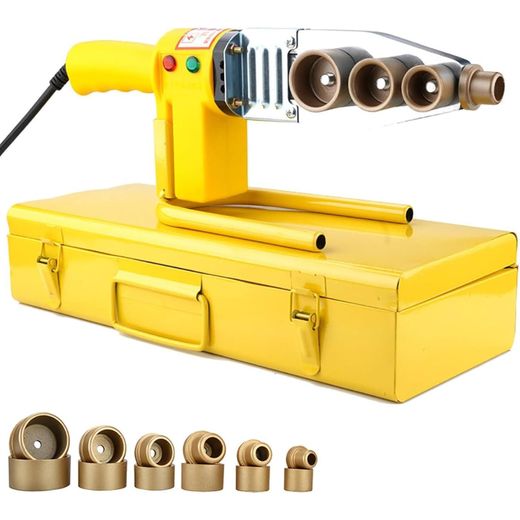
Keep the device clean and dry when not in use, and inspect the power cable for wear before each job. Use the thickened anti-scalding cable design and insulated layers to prevent heat hazards, and rely on multiple cooling holes to speed heat dissipation after use. Store tools in a sturdy steel box or case to protect components and prevent damage during transport.
What should I expect to receive in a typical welding kit?
A standard kit usually includes the welding tool, a set of dies (e.g., 20/25/32/40/50/63 mm), a measuring tape, hex keys or screwdrivers, a pipe cutter, and sometimes a stand or mounting screws. Some offerings also provide a protective case and multiple heads to cover a wide range of pipe sizes. These extras help you complete precise fusions with less downtime between tasks.
How do I pick between models with similar specs from this range?
Compare the included accessories and build quality: a steel box packaging or a rugged carrying case adds transport convenience, while features like digital temperature display and rapid heat-up times shorten work cycles. Check for safety features such as anti-scalding cables and robust cooling designs. Finally, verify that the machine supports the pipe types you commonly use (PPR, PE, PP, PB) to ensure long-term compatibility.